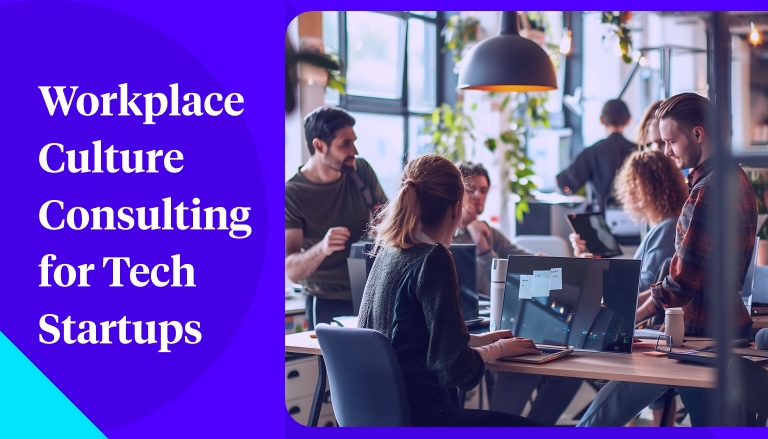
Workplace culture consulting for tech startups helps founders and early leaders define the behaviors that drive business results, align their leadership teams, and maintain those behaviors as the company grows. Rapid hiring, new management structures, and hybrid work arrangements can make it difficult to preserve the practices that helped a startup succeed in its early stages. This article outlines why workplace culture matters for tech startups, the challenges of building culture in hybrid teams, and how a culture consultant can support growth.
Why Does Workplace Culture Have Such a Big Impact on Tech Startup Growth and Success?
Workplace culture influences how a tech startup makes decisions, responds to challenges, and achieves its business objectives. The habits established during a company’s earliest stages often become its default way of operating, even as the organization grows.
Without intentional culture development, practices that work for a small founding team may become obstacles as the company hires more employees, introduces management layers, and expands operations.
How Do Founders Shape a Tech Startup’s Culture?
Founders shape startup culture through their decisions, leadership behaviors, communication styles, and hiring practices. Employees observe these behaviors and often adopt them as expectations for how work should be completed.
This influence is not always intentional. According to research summarized by HEC Paris, founders often carry the culture of their previous employer into their new startup, including practices they disliked.
As a startup grows, its culture becomes increasingly dependent on whether leaders consistently reinforce the behaviors that support business objectives. If expectations remain tied to individual founders rather than shared organizational practices, maintaining consistency can become more difficult as leadership responsibilities expand. According to a 2026 U.S. Census Bureau working paper, founder departures significantly increase employee turnover, with larger effects in older and larger startups.
What Happens to Startup Culture During Rapid Growth?
Rapid growth can expose weaknesses in a startup’s workplace culture because informal practices become harder to maintain as headcount increases.
A team of 15 employees may rely on direct communication and close relationships with founders. At 50 or 150 employees, the same approach may create confusion around responsibilities, decision-making, and accountability.
Common cultural pressure points during startup growth include:
- Hiring waves after funding rounds: Rapid recruitment can make it difficult to communicate shared expectations consistently to new employees.
- Introducing the first management layer: Early employees promoted into leadership roles may lack experience managing people and reinforcing organizational expectations.
- Expanding into new offices or time zones: Teams may develop different communication habits and decision-making approaches.
- Changes in founder involvement: As founders delegate responsibilities, employees may receive different signals about priorities and acceptable behaviors.
- Increasing performance expectations: Pressure to meet growth targets can lead leaders to introduce processes or controls that conflict with the startup’s established culture. According to the Stanford Graduate School of Business, tech startups that changed their founding employment model, sometimes under investor pressure, were three times more likely to fail.
Addressing these challenges early can help startups maintain consistent expectations without relying on informal practices that become less effective at scale.
What Makes Culture Harder to Build at a Hybrid Tech Startup?
Building culture at a hybrid tech startup is more challenging because employees split their time between remote and in-office work. Workplace culture consulting for hybrid tech startups helps organizations establish shared expectations around communication, collaboration, leadership, and accountability when employees are not consistently working in the same location.
Hybrid arrangements can create differences in how employees experience the workplace. Employees who regularly attend the office may have more opportunities for informal conversations with leaders, while remote employees may rely on scheduled meetings and digital communication.
These differences can affect access to information, participation in decisions, and perceptions of fairness.
To maintain a consistent culture, hybrid startups need to establish when in-person collaboration is valuable, how decisions are communicated, and how employees are evaluated regardless of where they work.
Hybrid startups need every employee to understand the same expectations and have comparable opportunities to contribute, wherever they work.
How Can a Tech Startup Improve Its Culture With a Consultant?
A tech startup can improve its culture with a consultant by:
- Assessing how workplace behaviors affect business results
- Defining shared beliefs before major hiring waves
- Aligning founders and early leaders
- Preparing first-time managers
- Building accountability into existing team routines
A workplace culture consultant provides an outside perspective on the behaviors and leadership practices that may be supporting or limiting growth. Rather than focusing exclusively on employee satisfaction, consulting connects culture development to business priorities such as retention, product delivery, customer outcomes, and organizational performance.
A startup can approach culture improvement with external consulting support in the following ways:
Assess How Culture Affects Startup Results
A culture consultant can begin by identifying how existing workplace behaviors influence the startup’s ability to achieve its goals.
This may involve gathering input from founders, executives, employees, and board members to understand differences between leadership expectations and day-to-day experiences.
For a growing startup, the assessment may examine how hiring and onboarding practices have changed, whether teams consistently meet delivery commitments, and how employees experience leadership across office and remote environments.
Culture Partners’ Culture Assessment evaluates four areas of organizational culture: adaptability, clarity, accountability, and alignment. These dimensions can help organizations identify where cultural practices may be limiting performance.
Define Shared Beliefs Before the Next Hiring Wave
Startups can strengthen their culture by identifying the beliefs and behaviors employees need to demonstrate to achieve important business outcomes.
These expectations should be specific enough to guide everyday decisions.
For example, a startup that values accountability might define what employees should do when project deadlines are at risk, including communicating concerns early, identifying obstacles, and taking responsibility for agreed-upon actions.
Establishing these expectations before a major hiring wave helps new employees understand how the organization operates rather than relying entirely on observing existing team members.
A structured approach to organizational culture transformation can help connect these shared beliefs to the results the company wants to achieve.
Align Founders and Early Leaders on Expectations
Leadership alignment helps ensure that founders, executives, and managers reinforce consistent expectations as a startup grows.
Early leaders may have different assumptions about how decisions should be made, how employees should be evaluated, or when teams should escalate problems.
These differences can create confusion when employees receive conflicting direction.
A culture consultant can facilitate discussions that establish shared priorities, clarify leadership responsibilities, and define the behaviors leaders are expected to demonstrate.
Culture Partners offers Executive Alignment Sessions to help leadership teams strengthen alignment around organizational priorities and the actions needed to achieve results.
Prepare First-Time Managers to Lead Hybrid Teams
First-time managers need practical leadership skills to maintain a consistent culture as startups introduce new management layers.
In many tech startups, employees move into management positions because of their technical expertise or individual performance. However, managing people requires additional skills, including setting expectations, providing feedback, coaching employees, and addressing performance challenges.
These responsibilities can become more complex in hybrid environments, where managers cannot rely on regular in-person interactions to understand employee needs or monitor progress.
A culture consultant can help managers establish consistent approaches to communication, feedback, and performance management across work arrangements.
Culture Partners’ Leadership Accelerator supports leadership development by helping leaders strengthen the behaviors needed to improve organizational results.
Build Accountability Into Sprints and Stand-Ups
Startups can strengthen accountability by incorporating cultural expectations into existing workflows rather than creating additional meetings or processes.
For technology teams, sprint planning, daily stand-ups, retrospectives, and one-on-one meetings already provide opportunities to reinforce shared behaviors.
For example, managers can use sprint retrospectives to discuss whether team members communicated risks early, followed through on commitments, and collaborated effectively when priorities changed.
The objective is to make accountability part of how work gets completed, rather than treating culture as a separate initiative.
Culture Partners’ Leadership Accountability Training focuses on helping leaders strengthen accountability and connect workplace behaviors to organizational performance.
When Should a Tech Startup Hire a Culture Consultant?
A tech startup should consider hiring a workplace culture consultant when organizational changes begin to create inconsistent expectations, leadership challenges, or performance problems.
Consulting can be particularly valuable before significant growth milestones, when leaders still have an opportunity to establish shared practices rather than correcting problems after they become widespread.
Common indicators include:
- Preparing for or completing a funding round that will significantly increase headcount.
- Introducing the company’s first formal layer of managers.
- Transitioning from fully remote operations to a hybrid work arrangement.
- Opening additional offices or expanding into new geographic markets.
- Experiencing increased turnover among early employees.
- Having founders step back from daily management responsibilities.
- Consistently missing business objectives despite having a clear strategy.
The appropriate consulting focus depends on the startup’s stage of development. The table below outlines the most common culture risk at each stage of growth and where consulting typically focuses.
| Startup stage | Common culture risk | What consulting focuses on |
| Founding team | Culture depends heavily on founder behaviors | Defining shared beliefs and leadership expectations |
| First funding and hiring wave | New employees receive inconsistent cultural signals | Establishing expectations and strengthening onboarding |
| First management layer | Inexperienced managers apply different leadership practices | Leadership development and accountability |
| Scaling across locations | Teams develop different communication and collaboration habits | Leadership alignment and consistent hybrid working practices |
Early-stage startups generally benefit from defining expectations before rapid expansion. As the company introduces managers and additional locations, consulting can shift toward leadership development, accountability, and maintaining consistent behaviors across teams.
Frequently Asked Questions
Why do hybrid startups need clear rules for in-office time?
Hybrid startups need clear expectations for in-office time to ensure employees understand when physical presence supports collaboration and when work can be completed remotely.
Rather than requiring office attendance without a defined purpose, startups can identify activities that benefit from face-to-face interaction, such as onboarding, strategic planning, mentoring, and complex team discussions.
Involving employees in establishing these expectations can also support perceptions of fairness. According to Gallup, 91% of employees say a hybrid schedule is fair when their team sets it, compared with 73% when leadership sets it.
A consistent approach helps prevent differences in office attendance from creating unequal access to information, leadership, or professional development opportunities.
How do team agreements strengthen hybrid startup culture?
Team agreements strengthen hybrid startup culture by establishing shared expectations for communication, collaboration, and decision-making across work locations.
These agreements help employees understand how to work together without relying on informal conversations or assumptions about availability. According to Gallup, hybrid teams with a formal collaboration plan are 66% more likely to be engaged and 29% less likely to experience burnout.
A hybrid team agreement may define:
- Communication rhythms: How frequently teams meet and which updates should be shared asynchronously.
- Availability expectations: When employees should be accessible for collaboration and how response times are managed.
- Decision-making responsibilities: Who has authority to make decisions and how those decisions are communicated.
- In-person collaboration: Which activities benefit from office attendance, such as planning, mentoring, or onboarding.
- Accountability: How commitments, progress, and performance are evaluated across work arrangements.
For growing startups, these agreements provide a consistent reference point as new employees join and existing teams expand.
How much does culture consulting cost for a tech startup?
The cost of workplace culture consulting for a tech startup depends on the scope of the engagement, the number of employees and leaders involved, and the organization’s specific challenges.
A focused engagement, such as leadership alignment or a culture assessment, will generally require fewer resources than a broader transformation initiative that involves multiple teams and management levels.
Factors that may influence the cost include the number of office locations and work arrangements, the extent of leadership involvement, and whether manager training or ongoing implementation support is required.
Startups should evaluate consulting costs relative to the business challenges they aim to address, such as employee turnover, inconsistent leadership practices, or missed performance objectives.
Culture Partners provides additional information about engagement considerations in its guide to the cost of a workplace culture consultant.
How Culture Partners Helps Tech Startups Build a Culture That Scales
Culture Partners helps organizations connect workplace culture to business results by focusing on the beliefs, behaviors, and leadership practices that influence performance. For growing tech startups, this approach can help establish consistent expectations as teams expand, management structures evolve, and employees work across different locations.
Depending on the organization’s needs, support can include:
- Culture assessment: Identifying gaps in adaptability, clarity, accountability, and alignment.
- Executive alignment: Helping founders and leadership teams establish shared priorities and expectations.
- Leadership development: Strengthening the skills managers need to guide employees and reinforce desired behaviors.
- Accountability training: Helping leaders connect everyday actions and commitments to organizational results.
By addressing culture alongside business growth, tech startups can establish practices that support their evolving teams without losing sight of the behaviors that contribute to performance.
Talk to a Culture Expert to explore how Culture Partners can support workplace culture development as your organization grows.